
How far would a dollar stretch in 1860 Tyler?
Did people have a dollar as we know it before the Civil War? At that time, the only money used was gold and silver coins, commonly referred to as specie. In 1862, President Lincoln authorized Congress to print currency. Foreign coins were widely circulated in the colonies, including the Spanish dollar, which was also known as pieces of eight. Silver and gold coins were exchanged by weight, and people often bartered, trading goods and services for other goods and services.
 Silver Eight Royals Coin of Ferdinand VII of Spain, 1821
Source of picture: By Coinman62 at English Wikipedia - Transferred from en.wikipedia to Commons., Public Domain, https://commons.wikimedia.org/w/index.php?curid=11936261
The census taker was tasked with asking respondents to summarize the total value of all their land and houses, regardless of location, and whether they owed any money on these properties. A similar inquiry was made regarding personal property, which encompassed all personal wealth.
One example is George Washington Chilton (1828 – 1884), who was born in Kentucky and worked as a lawyer while living in Tyler in 1860. He is recorded as having real estate valued at $2,000 and personal property valued at $3,500. In today’s dollars, this would equate to approximately $100,518.
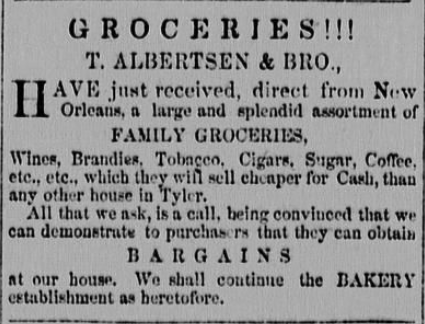
Another example is Tom Albertson (1832-1893), a merchant born in Norway who arrived in Tyler around 1856. He worked alongside his father and brothers as a baker and shoemaker. His records show that his real estate was valued at $2,000 and his personal property at $1,000, which would be equivalent to about $86,158 today.
Lastly, there's William Green (1815-1879), a farmer born in North Carolina who moved to Tyler around 1850. He owned property on Old Bullard Road and served as a city commissioner. His real estate was valued at $3,500, with personal property at $1,500, which translates to roughly $143,597 in today’s currency.
So, what does this information indicate? It provides a glimpse into the relative net worth of these families. To understand what this money could buy, we can look at what the dollars were worth at that time.
Using an inflation calculator, we find that one dollar in 1860 is equivalent to about $28.72 today. In 1860, land sold for $1-$3 per acre; however, like today, the price heavily depended on location.
For instance, regarding a commodity close to my heart: in 1860, roasted coffee could be purchased for 23 cents per pound. Flour and cornmeal cost about 2 to 3 cents per pound, while horses ranged from $40 to $100, depending on age and condition. A wagon or buggy would set a buyer back around $65 to $75.
Below is an advertisement from Tom Albertsen & Bro. Store:

Source: The Tyler Reporter. (Tyler, Tex.), Vol. 6, Ed. 1 Thursday, April 11, 1861, newspaper, April 11, 1861; Tyler Texas. (texashistory.unt.edu/ark:/67531/metapth181842/m1/3/?q=%20%22Albertsen%22: accessed May 20, 2018), University of North Texas Libraries, The Portal to Texas History, texashistory.unt.edu; crediting The Dolph Briscoe Center for American History.
The information provided on this page is an accumulation of work and research completed by our Society and volunteers. If you are interested in correcting or adding information to this page, please leave a comment below or email us at info@smithcountyhistoricalsociety.org.
0 Comments